Budget-Friendly Backyard Lighting: 4 Easy Ways to Start
If your backyard disappears as soon as the sun goes down, adding lighting can feel like a bigger project than it needs to be. Where should the lights go? Do you need an outdoor outlet? And how much do you really need to buy?
Start with the spot you want to use.
Maybe you’d like to sit on the patio after dinner. Maybe the walk to the back gate is too dark. Or maybe you just want a little light on the table while you enjoy an evening outside.
These four budget-friendly backyard lighting ideas each solve a different problem. Choose the one that fits your space, start small, and see how it feels after dark before adding more.
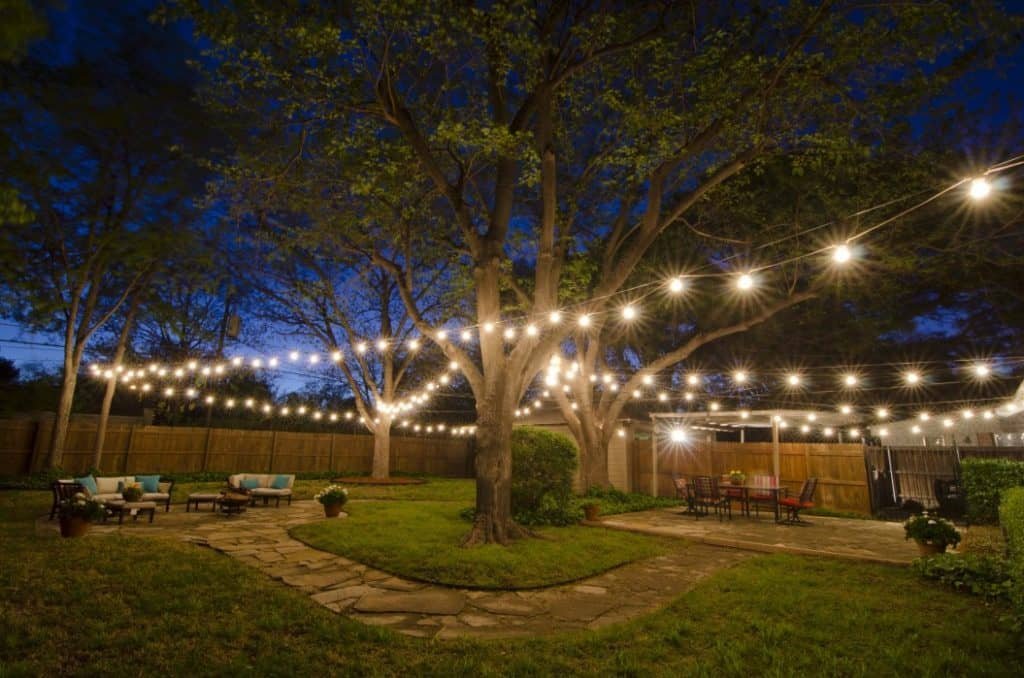
Table of Contents
1. String Lights for a Patio or Seating Area
Start here if: You want your outdoor seating area to feel more inviting.
String lights can help define a patio, deck, or small seating area. A strand above the space gives you a place to gather, whether you have a full outdoor dining setup or a couple of chairs by the back door.
As an Amazon Associate I earn from qualifying purchases.
For a first project, focus on the area where people sit. You can always expand the layout later.
How to make them work in your space
Plan the route before choosing a strand. Measure between the attachment points, allow for the drape recommended by the manufacturer, and check the distance from the outlet to the first bulb.
That last measurement is easy to overlook. Part of the cord may need to reach the seating area before the lighting even begins.
If you don’t have trees, you still have options. Depending on your setup, a pergola, suitable posts, or purpose-built string light poles may provide attachment points. Our guide to hanging backyard string lights without trees can help you explore a layout.
Where to spend—and where to save
Start with one seating area and a simple route. Extra strands, poles, mounting hardware, and extension cords can all add to the total.
Look for outdoor-rated lights, check the mounting instructions, and confirm whether a dimmer is included or requires a separate compatible accessory. Follow the manufacturer’s support requirements rather than assuming the light cord can carry a long span on its own.
A simple first project: Light the area above your outdoor table or main seating spot.
2. Solar Path Lights for a Sunny Walkway
Start here if: You want to outline a garden path without running a power cord.
Solar stake lights are worth considering along a sunny walkway or the edge of a planting bed. They let you add small points of light without connecting each fixture to an outlet.
The deciding factor is the location of the solar panel. A path that looks perfect for lighting may sit beneath trees or beside a fence that shades it for much of the day.
Before buying, check the manufacturer’s sunlight requirements against the spot where the panel will actually sit.
Place a few before buying more
Start with a short section of path. Position the lights temporarily, let them charge according to the instructions, and check the result after dark.
Look at the ground between the fixtures. Can you see the route clearly, or are you mostly seeing bright dots?
Adjust the placement before installing the rest. Keep stakes out of the walking surface and away from places where a mower or trimmer will hit them.
Know what you need the lights to do
Decorative path markers and lights that illuminate a walking surface can produce very different results. Check brightness information and real installation photos rather than choosing by the daytime appearance alone.
For steps, uneven ground, or a route you depend on every night, choose lighting that provides dependable visibility. A faint decorative glow may not meet that need.
A simple first project: Try a small set along one sunny section of walkway and assess it after dark.
3. Battery or Rechargeable Lanterns for a Table
Start here if: You want light beside your chair or on a dining table, with very little setup.
A portable lantern is an easy place to begin. Set it on the table, turn it on, and move it when you rearrange the furniture.
It’s especially useful for a small patio, a rental, or a seating area where hanging lights would take more work than you want to tackle.
An enclosed LED lantern also gives you a decorative glow without managing an open flame.
Choose light you’ll enjoy sitting beside
Look for adjustable brightness and a shaded or diffused light source. A lantern can look lovely in a product photo but feel glaring when it’s directly in front of you.
Warm-colored light is a good starting point for a relaxed seating area. Keep the brightness only as high as you need, and turn lights off when you’re finished outside. Those choices follow DarkSky’s principles for responsible outdoor lighting.
Check the everyday details
Before buying, look at:
- Whether it uses replaceable batteries or needs charging.
- The stated runtime at the brightness you expect to use.
- Whether it is rated for outdoor exposure.
- Whether it needs to come inside after use.
One lantern you regularly use can be a better starting purchase than a matching collection that needs constant charging or storage.
A simple first project: Add one lantern to the table beside your favorite outdoor chair.
4. Motion-Sensor Lighting for a Dark Entrance or Gate
Start here if: You need light while unlocking a gate, taking out the trash, or coming through the back door.
Some areas need practical lighting more than decorative lighting. A motion-sensor fixture can provide light when you pass through without keeping the area illuminated all evening.
Choose the power source around the location. Battery models need accessible battery compartments. Solar models need suitable sunlight. Hardwired fixtures involve electrical installation.
Aim at the task
Position the fixture to light the latch, doorway, or walking surface you need to see.
Then test it after dark. Check whether it activates where you need it, whether the light reaches the ground, and whether it shines into neighboring windows or your seating area.
Adjustable direction, sensitivity, and shutoff timing can be more useful than choosing the brightest fixture available.
Include installation in the budget
Compare the complete setup, including mounting hardware and any installation work.
If the project requires new wiring or changes to an electrical circuit, have a qualified electrician handle that work.
A simple first project: Light the route between your back door and the gate or trash bins.
How to Choose Your First Backyard Light
Choose the problem you most want to solve:
- You want to linger on the patio: Start with string lights.
- You want to outline a sunny garden path: Try solar path lights.
- You want light on a table tonight: Choose a portable lantern.
- You need to see at a dark entrance: Consider a motion-sensor fixture.
Before buying anything, spend a few minutes outside after dark with your existing lights on. Notice where you naturally sit, where you walk, and where you struggle to see.
You may discover that one corner needs attention while the rest of the yard works well as it is.
Start With One Spot
You don’t need to finish the whole backyard at once.
Choose one seating area, one stretch of path, or one dark entrance. Set up the lighting, use the space for a few evenings, and decide what would make it more comfortable.
That gives your next purchase a purpose—and helps you build a backyard you enjoy after sunset without buying everything at once.1. String Lights